 Pin This
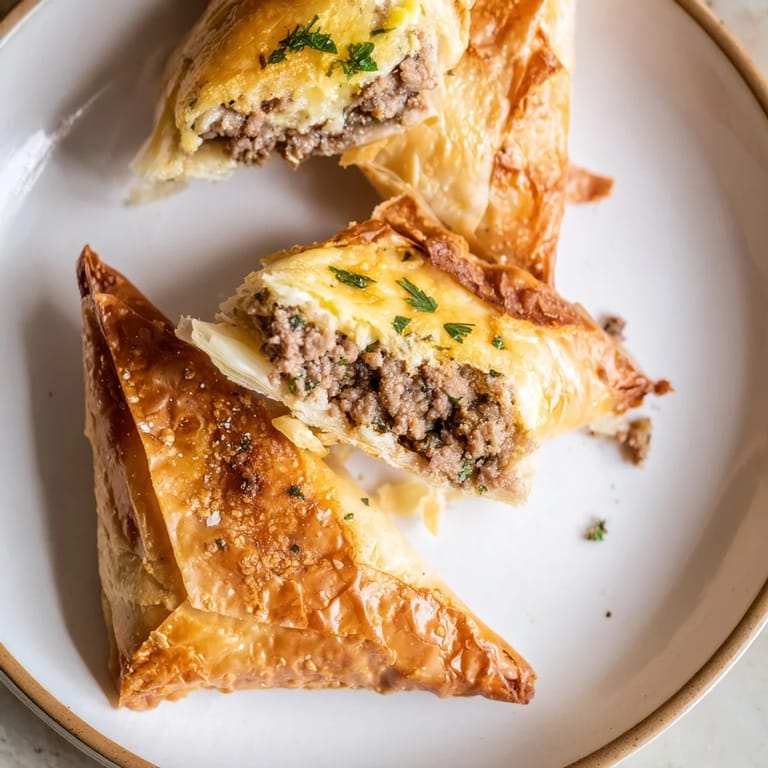
 The first time I bit into a brik at a bustling Tunis market, I was struck by the violent crunch of the pastry giving way to the warm, runny yolk inside—it was messy, immediate, and absolutely unforgettable. Years later, when I finally learned to make them myself, I realized that golden moment wasn't luck but technique: the oil had to be just hot enough, the fold had to be tight enough, and the egg had to still be slightly loose in the center. Now, whenever I make briks, I'm chasing that same sensation, that perfect balance between crispy shell and liquid treasure at the heart.
I made these for my neighbor one afternoon when she mentioned she'd never had Tunisian food, and watching her eyes go wide when the yolk broke across the crispy pastry felt like introducing her to something sacred. She asked for the recipe immediately, and I remember thinking how food like this—simple but demanding—has this quiet power to make moments feel bigger than they are.
Ingredients
- Ground beef or lamb, 120 g: This is the savory spine of the filling; lamb gives a deeper, more authentic flavor, but beef works beautifully too and is easier to find.
- Small onion, finely chopped: Don't skip the mincing—the smaller the pieces, the more evenly they distribute through the filling and cook down into sweetness.
- Fresh parsley, 1 tbsp chopped: This adds brightness at the end; add it after cooking so it stays green and vibrant rather than turning dull.
- Ground cumin, 1 tsp: This is where the Tunisian warmth comes from; don't be timid with it.
- Ground coriander, 1/2 tsp: A subtle floral note that rounds out the spice profile and keeps the filling from tasting one-dimensional.
- Salt, 1/2 tsp and black pepper, 1/4 tsp: Season generously; the filling should taste almost aggressively seasoned before the egg and pastry soften it.
- Phyllo pastry sheets, 4 large: Handle these with respect—they're delicate and will tear if you rush, but they're also incredibly forgiving once you accept they might not be perfect.
- Large eggs, 4: Use the freshest eggs you can find; older eggs spread too much when they hit the hot oil.
- Gruyère or mozzarella cheese, 4 tbsp grated: This is optional but traditional in some versions; it adds a savory depth and helps bind the filling slightly.
- Sunflower or vegetable oil for frying: You need enough to come up about 3–4 cm in the pan; don't try to deep fry these in shallow oil or they'll be greasy.
Tired of Takeout? 🥡
Get 10 meals you can make faster than delivery arrives. Seriously.
One email. No spam. Unsubscribe anytime.
Instructions
- Build the flavor foundation:
- Warm a skillet over medium heat and sauté the chopped onion in a little oil until it's soft and starting to turn golden; this takes about 3–4 minutes and mellows out the raw onion sharpness. Add your ground meat, cumin, coriander, salt, and pepper, stirring often until the meat is completely browned and cooked through—you'll know it's done when there are no pink bits and the spices smell toasty and alive.
- Prepare your pastry canvas:
- Lay a phyllo sheet on a clean, dry surface and have a small bowl of water nearby for sealing. If your phyllo sheets are gossamer-thin, layer two together for more structure, but one sheet is usually sturdy enough.
- Fill with purpose:
- Spoon 2–3 tablespoons of the cooled meat mixture into the center of the sheet, leaving space around the edges so you can fold without the filling bursting out. Make a small well in the filling with the back of a spoon and crack an egg directly into it; the yolk should sit in that little nest you created.
- Optional richness:
- Sprinkle 1 tablespoon of grated cheese over the egg if you're using it; it will melt slightly and add a savory richness.
- Seal like you mean it:
- Dip your finger in the water and run it along the edges of the phyllo, then fold the sheet over the filling to form a triangle or rectangle—the shape doesn't matter as much as making sure the edges are sealed tight so the egg doesn't escape during frying. Press down gently but firmly to lock everything in place.
- Get the oil ready:
- Pour oil into a large frying pan to a depth of 3–4 cm and heat it over medium-high heat; test if it's ready by dropping in a tiny piece of phyllo—if it sizzles and turns golden in a few seconds, you're good. If it smokes heavily, the oil is too hot and will cook the outside before the egg inside has time to set.
- The critical fry:
- Carefully slide a filled pastry into the hot oil and let it sit undisturbed for 2–3 minutes until the bottom is deep golden brown. Flip it gently with a slotted spoon and fry the other side for another 2–3 minutes until it's equally golden and crispy all over.
- Rest and serve:
- Remove the brik with a slotted spoon and place it on a paper towel-lined plate to drain excess oil. Serve while it's still hot and the pastry is at its most shatteringly crisp.
 Pin This
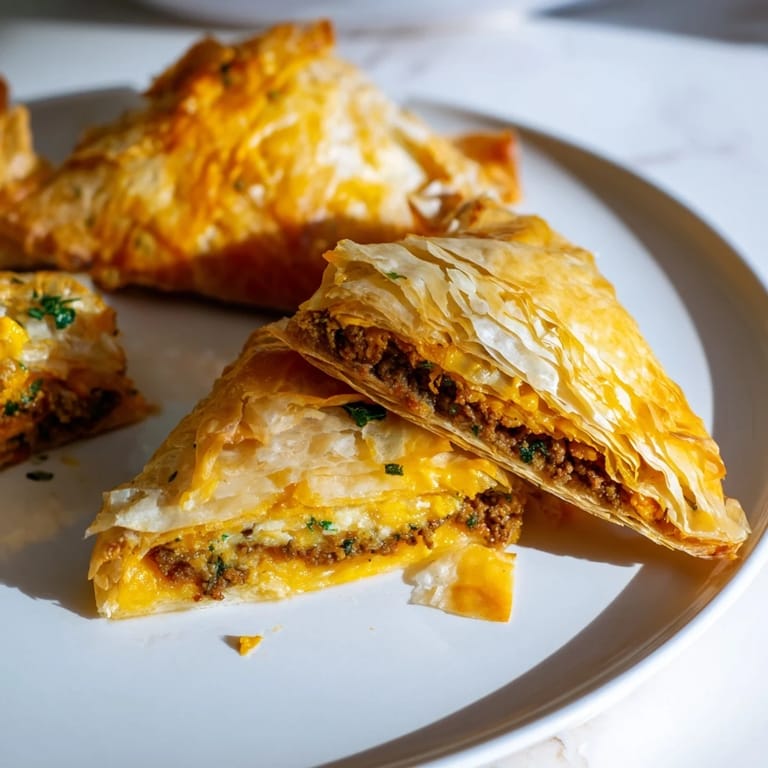
 There's a particular magic in that moment when you bite through the shattered pastry and the warm yolk cascades across your tongue—it's the reason these pastries have survived generations of street vendors and home cooks. Every culture with fried pastry knows some version of this trick, but the Tunisians got it exactly right.
The Art of the Perfect Fry
The oil temperature is everything here, and the best way to check it without a thermometer is the sensory method: a small piece of phyllo should float down slowly, sizzle immediately but not violently, and turn golden in about 10–15 seconds. If it blackens in 3 seconds, your oil is screaming and you need to pull the pan off the heat and wait. If it just sits there looking sad, the oil isn't hot enough yet. Once you nail this, you'll make perfectly golden briks every single time.
Variations and Flexibility
The beauty of briks is that they're a blank canvas for whatever you have on hand or whatever you're craving that day. Swap the meat for canned tuna mixed with a little mayo and capers, or use mashed potato with cheese for a vegetarian version that's just as satisfying. Some versions add a pinch of harissa or chili flakes to the meat filling for heat, while others stay mild and let the egg be the star. The core technique stays the same; only the filling changes.
- Try a combination of ground lamb and a small pinch of harissa for an extra layer of flavor.
- Mozzarella gets stringy and melts beautifully, while Gruyère adds a nuttier, more sophisticated edge.
- If you can't find phyllo, spring roll wrappers work in a pinch and fry up just as crispy.
Serving and Timing
These are non-negotiable eaten immediately, straight from the paper towel and still steaming; as they cool, the pastry loses its shatter and becomes chewy. A squeeze of fresh lemon adds brightness and cuts through the richness of the oil and yolk. A simple green salad alongside—just arugula or mixed greens with a light vinaigrette—makes this feel like a complete meal rather than just a snack.
 Pin This
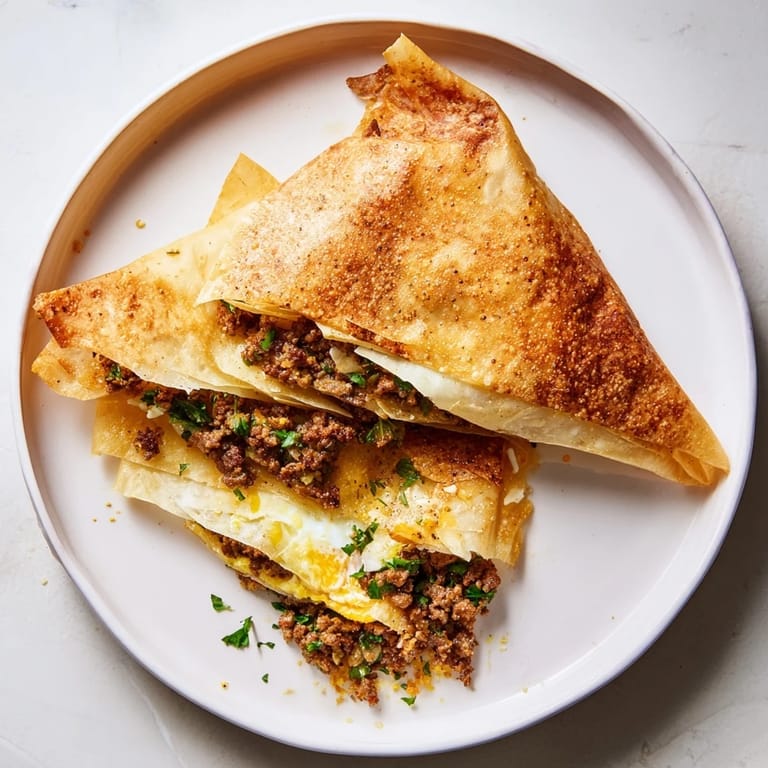
 These pastries are proof that sometimes the simplest combinations—crispy, savory, and a runny egg—are the ones that linger longest in memory. Make them once and you'll understand why they've been a street food staple for so long.